

Population ageing is reshaping societies across Asia and the Pacific with impacts on the labour force, care systems including family support, fiscal sustainability and social protection systems.
Population ageing does not only mean that people are living longer or that there are more older persons in a country. With people of different generations co-existing for longer periods of time, population ageing challenges how societies are organized and how generations interact in the political, social and economic realms. The “generational economy” refers to the system of social institutions, economic mechanisms and intergenerational flows through which different age groups produce, consume, share and allocate resources over the life course. With the share of older persons increasing, the system of mutual support across generations is under pressure.
A critical challenge is the large share of older persons and workers in the informal economy. Many informal workers lack adequate pensions, health insurance and other forms of social protection throughout their working lives, increasing their risk of poverty and vulnerability in old age. With family and household sizes declining, fewer family members are available to support older family members in times of crisis.
To design informed policies, it is crucial to generate evidence. National transfer accounts (NTA) demonstrate how economic resources are produced, consumed and redistributed across generations, while emerging national inclusion accounts (NIA) provide insights into inequalities and exclusion experienced by different population groups across the life course. Together, these tools and the data they produce offer policymakers a stronger evidence base for designing inclusive ageing policies.
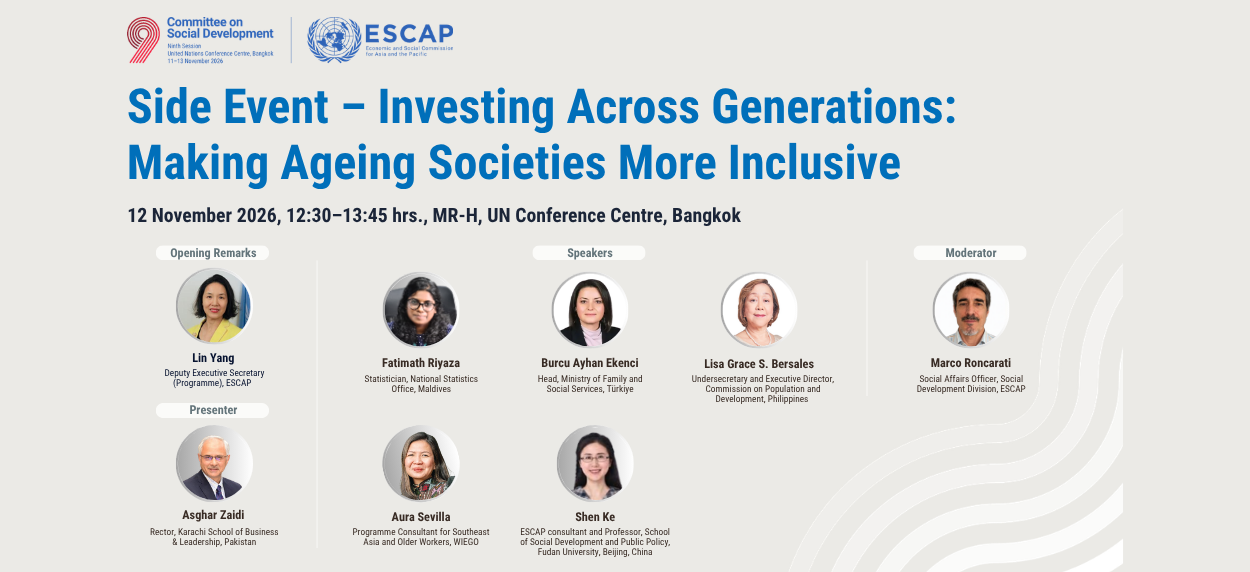
This side event, organized in the context of the Ninth Session of the Committee on Social Development (CSD9), will bring together policymakers, researchers, UN entities and development partners to discuss investments across generations to make ageing societies more inclusive.